

Studying for the IELTS could be daunting. But when we understand the IELTS band descriptors, it becomes easier to know what examiners expect. Such descriptors provide us with an idea of how speaking and writing sections of the test are evaluated.
In this blog, we will explore the key aspects of the IELTS scoring criteria, including the IELTS speaking band descriptors and IELTS writing band descriptors. Knowing these will be beneficial to us in enhancing our band score and mastering the test with more confidence.
What Are IELTS Band Descriptors?
The IELTS band descriptors are official scoring guidelines used by examiners. The descriptors apply to the Academic and General Training modules. The assessors test performance using well-understood criteria and award grades between Band 0 and Band 9.
Now we are going to analyze the criteria of assessment that is done in IELTS speaking and IELTS writing so that we can have better preparation.
IELTS Speaking Band Descriptors
The IELTS speaking assessment is based on four main categories. These determine how fluently and clearly we can express our ideas in English.
- Fluency and Coherence
This is the ability to talk without excessive pauses and repetition easily. We have to relate our ideas appropriately using relationship words such as first, next, and finally. We should not have long pauses and keep our ideas in order to score high.
- Lexical Resource
This tests our word power. Do we employ diverse words? Are we capable of paraphrasing or being natural using idioms? The examiner will see whether we say the same words or use correct collocations such as strong opinion or environmental issues.
- Grammatical Range and Accuracy
Simple as well as complex sentence structures must be presented. We can score more, e.g., by employing conditional or relative clauses. When there are fewer grammar errors, the communication becomes stronger and clearer
- Pronunciation
Clarity is key here. Examiners listen for correct word stress, intonation, and rhythm. Even if we have an accent, clear pronunciation can earn us a good score.
IELTS Writing Band Descriptors
The writing test is scored using four categories, much like the speaking test.
- Task Achievement (Task Response for Academic)
We must answer the question completely. This means writing enough words and covering all parts of the prompt. Clear opinions or summaries should be present, depending on the task type.
- Coherence and Cohesion
We need a logical flow. Our paragraphs should link smoothly, and we should use cohesive devices such as “however,” “on the other hand,” and “therefore.”
- Lexical Resource
Again, vocabulary matters. Using a variety of words without overusing uncommon or memorized phrases helps us sound natural and clear.
- Grammatical Range and Accuracy
We should demonstrate control over grammar. Using a mix of tenses, active and passive voice, and varied structures will help raise our score.
Understanding IELTS Test Scores
Results are issued in the form of a Test Report Form. It reflects the total band score and the individual scores of listening, reading, writing, and speaking.
The four section scores are added together, and the total is divided by 4 to give the overall band score. This mean is truncated to half band or full band. E.g., an average that terminates at .25 is rounded up to the nearest half band, and one that ends at .75 is rounded up to the next full band.
Here is an illustration
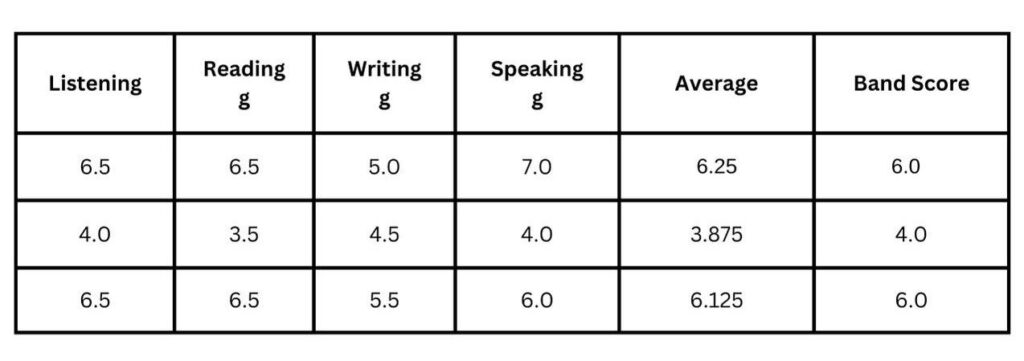
This method insures fairness and accuracy in reporting performance.
IELTS Band Scores and Skill Levels
The IELTS scale ranges from Band 0 to Band 9, each reflecting a different level of English ability
- Band 9 Expert
Full command of English with complete accuracy and fluency.
- Band 8 Very Good
Strong command with rare inaccuracies, though occasional misinterpretations in unfamiliar settings may occur.
- Band 7 Good
Operational use with some errors, but good handling of complex language..
- Band 6 Competent
Effective use despite mistakes; capable of managing complex language in familiar contexts..
- Band 5 Modest
Partial command; able to manage general meaning but with frequent errors.
- Band 4 Limited
Competence restricted to basic, familiar situations; frequent issues in expression and comprehension.
- Band 3 Extremely Limited
Can convey only very simple meaning in highly familiar situations; frequent communication breakdowns..
- Band 2 Intermittent
Knowing about English-speaking cultures helps communicate. Find out about trends, humour, and social conventions. Knowing this knowledge causes conversations to be easier and more fulfilling.
- Band 2 Non -user
Severe difficulty understanding spoken and written English
- Band 1 Non-user
No real ability apart from isolated words
- Band 0 Did not attempt
Test was left unanswered.
How Are IELTS Band Scores Calculated?
Every criterion is rated between 0 and 9. All four scores are averaged to come up with the final band for that section. For example, if a person scores 7 in fluency, 6 in grammar, 7 in vocabulary, and 8 in pronunciation, the average will be 7.0.
This system provides a fair and consistent assessment based on the IELTS official scoring criteria.
Why Understanding IELTS Band Descriptors Matters
When we have some idea of what the examiners want, we are able to practice in the correct direction. Whether it’s working on grammar, improving vocabulary, or developing better structure in essays, the IELTS band scores explained give us a clear road map to follow.
It also assists us in self-evaluation. It is possible to compare our performance with these descriptors after a practice session to find out in which areas we still have to work.
Final Step: Turning Insight into IELTS Results
Mastering the IELTS band descriptors is a crucial part of test preparation. By understanding how the IELTS speaking band descriptors and IELTS writing band descriptors work, we can align our efforts with what truly matters.
We advise every learner to go through the IELTS scoring systems frequently and train with constructive judgment. To have your desired band is possible with the right concentration.
We should not only take the IELTS but also pass it with a lot of confidence.